Best Lunch in Málaga: Complete Guide to Eating Like a Local
Lunch in Málaga is not a meal you rush. The city has not caught up with the northern European habit of eating a sandwich at your desk and calling it done. Here, the midday meal is still the main event — the anchor of the day around which everything else is loosely organised.
Restaurants fill up between 2pm and 3pm, conversations last longer than the food does, and a glass of local wine at noon on a Tuesday is entirely unremarkable.
That rhythm is one of the things I find makes eating lunch in Málaga different from eating lunch anywhere else in Europe. Work with it and it rewards you. Fight it — try to eat at 12:30pm, want to be out in forty-five minutes — and you will find it harder, though not impossible.
I have built this guide around the full range: the institution of the menú del día, the neighbourhood spots that deserve more attention than they get, the quick options for when time is actually short, and the places worth booking properly. The supporting guides below go deeper on each category.
Best lunch in Málaga — quick decision guide
Best time to arrive2pm — restaurants full, kitchen at pace, no waiting
Menú del día price range€10-16 — two courses, bread, drink, dessert
Best area for varietyStreets around Atarazanas Market
Best area for seafoodLa Malagueta promenade or El Palo / Pedregalejo
Dish to order firstPorra antequerana + boquerones fritos
Menú del día availableMonday to Friday — rarely Saturday, never Sunday
The Menú del Día: the point of the whole thing
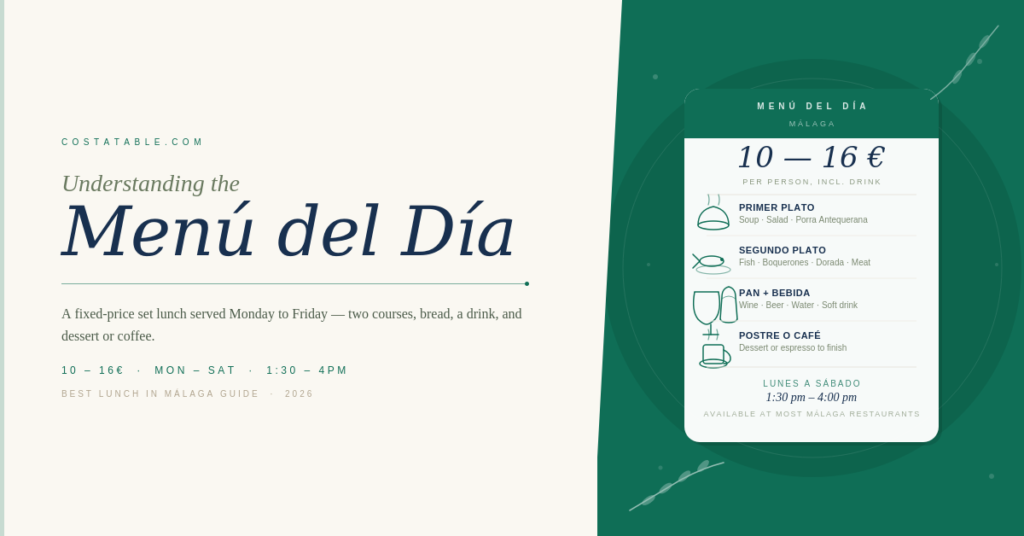
Before covering specific restaurants, this is worth understanding properly. The menú del día is a set lunch menu offered by most restaurants in Spain from Monday to Friday, sometimes Saturdays. For a fixed price — typically between ten and sixteen euros in Málaga depending on the restaurant — you get a first course, a second course, bread, a drink (wine, beer, water, or soft drink), and usually a dessert or coffee.
The quality of the food is not a lesser version of the à la carte menu. In most cases, it is the kitchen doing what it does every day at its natural pace, using whatever was good at the market that morning. The menú del día at a traditional Málaga restaurant is how you eat well for not much money without making any effort.
What you will typically choose from: first courses that run to salads, soups, porra antequerana (the thick cold tomato soup that is Málaga’s answer to gazpacho), coquinas (small clams in broth), or berberechos. Second courses lean toward fish — boquerones fritos (fried anchovies), dorada a la sal (sea bream baked in salt crust), cazón en adobo (marinated dogfish) — alongside meat options like carrillada de cerdo (braised pork cheek) or rabo de toro (oxtail stew, particularly good in autumn and winter).
The drink included with the menú is not an afterthought. A glass of house wine or a cold beer at lunch is normal and expected. The Moscatel wines produced just outside the city — from the villages of Moclinejo and El Borge — occasionally appear on wine lists and are worth trying, particularly with dessert.
A practical note: most restaurants start their menú service at around 1:30pm and stop taking orders by 3:30pm or 4pm. Turn up at 2:15pm on a weekday at any decent neighbourhood restaurant and you will probably be eating within ten minutes.
| Element | What you get | Notes |
|---|---|---|
| First course | Salad, soup, porra, coquinas, or berberechos | Usually 3-4 choices. This is where the kitchen shows its character. |
| Second course | Grilled fish, fried fish, meat stew, or grilled meat | Ask what came in today. The answer tells you what to order. |
| Bread | Included. Always. | Order olive oil if it is not already on the table. |
| Drink | House wine, beer, water, or soft drink | Wine at lunch is unremarkable here. Order it. |
| Dessert or coffee | Usually included — fruit, flan, or a coffee | Some kitchens offer a small sweet wine with dessert. Take it. |
| Price | €10-16 in most neighbourhood restaurants | Below €10 in the city centre is usually a warning sign. |
What to order at lunch in Málaga
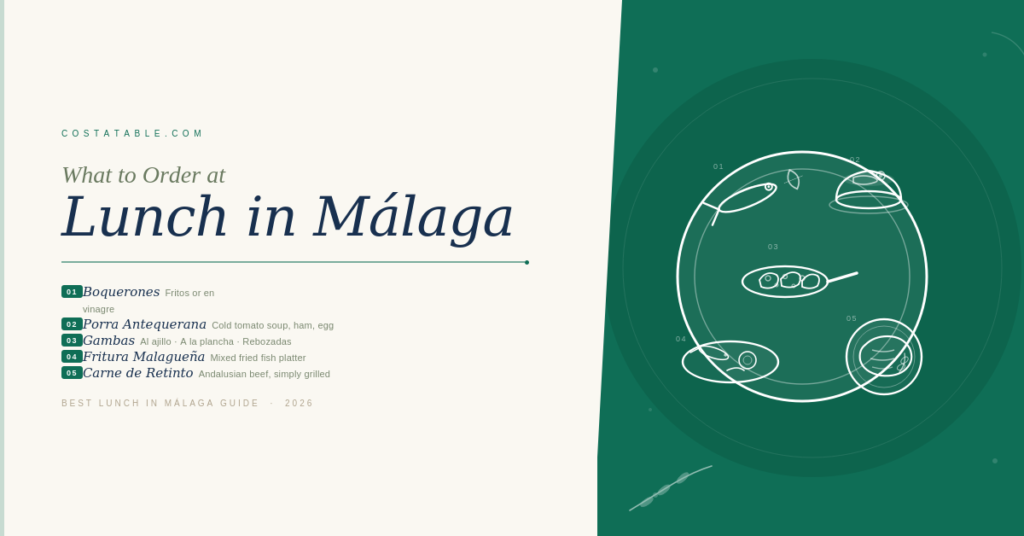
If you are eating à la carte rather than from the menú — or if you are at a tapas bar choosing freely — these are the things worth knowing about.
Boquerones appear in two forms. Fritos (fried in flour) or en vinagre (marinated in vinegar until white). The fried version is the lunch staple — fresh anchovies, barely battered, eaten hot with lemon. The vinegared version is sharper, often eaten as a bar snack earlier in the day. You will see both versions everywhere. The quality is entirely dependent on how fresh the fish is, which is entirely dependent on where you eat them.
Porra antequerana is the cold tomato and bread soup that locals will tell you is better than gazpacho, and they are not wrong. It is thicker, richer, and more satisfying than gazpacho. It comes topped with strips of cured ham and chunks of hard-boiled egg. On a hot afternoon, eating a bowl of porra with some fried fish on the side is close to a perfect Málaga lunch.
Gambas — prawns — appear in several forms. Al ajillo (in bubbling olive oil and garlic, best eaten immediately), a la plancha (griddled, simpler, sometimes better), or rebozadas (battered and fried, less common but very good). The local Málaga prawn — gamba blanca malagueña — is fished out of the bay and has a flavour noticeably different from the frozen variety. Ask, because it matters.
Fritura malagueña is the mixed fried fish platter that appears on most lunch menus near the coast: a combination of boquerones, calamar, gambas, chopitos (baby squid), and whatever else the kitchen has decided to include that day. Eaten at a chiringuito on or near the beach, it is one of the defining lunch experiences of the city.
Carne de retinto — beef from the retinto cattle breed, native to Andalusia — appears on more menus than it used to. Slowly it is becoming something Málaga chefs are proud of rather than something they take for granted. A good version at lunch, simply grilled, is hard to beat.
✅ Frank’s five rules for eating lunch in Málaga
- Arrive at 2pm, not noon. The kitchen is not ready at noon and neither is the city. Coffee and a pastry fill the gap. The menú does not start until 1:30pm at the earliest and is worth waiting for.
- Read the handwritten board, not the laminated menu. The handwritten board is what the kitchen cooked today. The laminated menu is what they always cook. One of these is fresh and one is not.
- Order the porra antequerana at least once. It is Málaga’s most overlooked dish and most visitors walk past it for soup they already know. Do not do that.
- Ask where the fish came from. A good kitchen in this city knows where its fish came from that morning. A kitchen that cannot tell you is not buying locally. The question takes five seconds and the answer tells you everything.
- Do not fight the pace. Lunch here takes as long as it takes. If you have somewhere to be at 3pm, tell the kitchen when you order. Otherwise, let it run.
The Neighbourhoods: where to go
🏛 El Centro and the historic quarter
Price range
€10-16
Best street
Calle Atarazanas
Crowd
Mixed local/tourist
Highest restaurant density in the city. Avoid the main pedestrian streets. The streets around Atarazanas Market — Calle Atarazanas, Calle Nueva, Calle Especerías — are where the real menú del día restaurants are. Full rooms at 2pm and handwritten menus are the signals that matter here.
🎨 Soho — the arts district
Price range
€15-30
Style
Modern kitchens
Pace
Slower, quieter
Smaller rooms, experimental menus, chefs who have trained elsewhere and brought different ideas back. Rooms fill more slowly — arriving at 2:30pm is fine here. Worth going if you want to be surprised by the kitchen rather than reassured by it.
🌊 La Malagueta and the seafront
Price range
€18-35
Best dish
Fritura / espetos
Quality varies
Choose carefully
Beach neighbourhood east of the port. Promenade restaurants vary enormously — some are very good, some trade on location. Look for kitchens that appear to be actually cooking and menus that change. The best lunch here is simple: espetos or a mixed fritura close enough to the beach to hear the sea.
🚌 Pedregalejo and El Palo
Price range
€10-20
Access
Bus or 20 min walk
Crowd
Mostly local
Former fishing villages east of the centre. Better seafood at lower prices than anywhere on the tourist trail. El Palo has traditional tapas bars where the Friday lunchtime menú involves whatever the boats brought in. This is the kind of thing you cannot plan for — you have to show up.
The best casual lunch spots in Málaga covers the centro area in more detail, including which specific streets are worth walking and which blocks to skip.
The hidden lunch spots in Málaga guide covers Pedregalejo and El Palo with specific recommendations for places that do not appear on the standard tourist routes.
The stylish lunch venues in Málaga covers the better Soho options alongside a few in the centro where the room has been given as much thought as the food.
Where to eat lunch in Málaga: choosing your restaurant
Knowing where to eat lunch in Málaga is as important as knowing what to order. The city’s restaurants vary dramatically in character, pace, and atmosphere — and choosing the right fit for your lunch depends entirely on what kind of experience you want.
The first question to ask yourself is simple: How much time do you have? If you have two hours and nowhere to be, the answer is almost everywhere. If you have ninety minutes, the menú del día restaurants near Atarazanas are your safest bet — they move faster than anywhere else in the city, and the quality is consistently good. If you actually have only forty-five minutes, you are fighting the culture of lunch in Málaga, and you should probably admit that and eat a montadito at the counter instead of forcing a sit-down meal.
The second question is what you want to eat. If seafood is non-negotiable, where to eat lunch in Málaga changes entirely. You should head east — either to the promenade restaurants at La Malagueta with the sea visible from your table, or further along the coast to Pedregalejo and El Palo, where the seafood lunch options are better and the prices are lower. If you want to eat cheaply and well, the streets around Atarazanas Market remain your best option. The cheap lunch restaurants in Málaga are not cheap because they cut corners; they are cheap because they do high volume with locals who know what they are getting.
The third variable is atmosphere. Are you eating alone at a bar, or do you need a proper table? Are you meeting a client, or having lunch with friends? The best lunch restaurants in Málaga varies depending on whether you want noise and energy or quiet and space.
⚠️ Tourist trap signals to watch for at lunch
- Laminated menus with photos. The photo menu exists for people who will not be back. A kitchen confident in its food does not need to show you a picture of it.
- Empty rooms at 2pm on a weekday. If locals are not eating here at peak hour, there is a reason. Keep walking.
- Staff outside pulling people in. Good restaurants in Málaga do not need to recruit from the pavement. Their regulars do the work for them.
- Menus in five languages with equal depth in all of them. A kitchen focused on cooking Andalusian food well does not have a fluent sushi section.
- Menú del día below €10 in the city centre. The ingredients reflect the price. It is not a bargain.
What often surprises visitors is how little the price difference matters. A menú del día at twelve euros and one at fifteen euros in the same neighbourhood is often the same quality of food — the difference is usually just the rent the restaurant pays. The real divisions in quality in Málaga are not vertical (by price) but horizontal (by location and kitchen focus). A kitchen that specialises in fish will make a better seafood lunch than a kitchen trying to do everything. A restaurant in the centro that has been serving tourists for thirty years will be different from a neighbourhood place that serves the same people every Friday.

The best approach is to trust the signals: handwritten menus, full rooms at 2pm, kitchen noise, and locals eating. These are the signs you are in the right place. If you see laminated menus, empty rooms at peak lunch hour, and only tourists, keep walking. For the widest range of casual lunch options in Málaga, explore our dedicated guide that covers the most relaxed and approachable spots.
Best lunch restaurants Málaga: a framework for every type
Best lunch restaurants in Málaga are not all trying to do the same thing, and understanding the different categories helps you find what you actually want rather than what the guidebook thinks you should want.
Traditional Menú del Día Restaurants: These are the backbone of lunch in Málaga. A menú del día typically costs between twelve and fifteen euros and includes two courses, bread, a drink, and often a dessert. The quality of the food depends entirely on how serious the kitchen is about cooking properly at scale. The best ones — usually in neighbourhoods away from the tourist centre — treat the menú as the showcase, not the afterthought. These restaurants fill up between 2pm and 3pm, and if you are not seated by 2:30pm on a weekday, you will wait. This is where to eat if you want to eat like locals do.
Seafood Specialists: Málaga’s best seafood lunch comes from restaurants that have made a decision to focus on fish and nothing else (or almost nothing). These are usually found near the coast — La Malagueta, Pedregalejo, El Palo — or in the streets immediately north of the harbour where the fish markets are. The menu changes depending on the catch. The price tends to be slightly higher because the ingredients are fresher and more carefully sourced.
Cheap Lunch Málaga Options: The cheapest good lunch in the city is not found in restaurants at all. It is found at the Atarazanas Market, where stalls sell fried fish and prepared food for standing-up eating at noon. The next tier is the montadito bars — small sandwiches on bread rounds, eaten at the counter for under eight euros. Then come the traditional tapas bars in neighbourhoods like El Palo, where a plate of five tapas and a beer is a full lunch for under ten euros. If you want to discover even more hidden affordable options, check out our guide to hidden lunch spots in Málaga.
Contemporary Restaurants: The newer Soho restaurants represent a different approach. The best lunch restaurants in this category tend toward smaller portions, more experimental menus, and wine lists that reflect personal choice rather than tradition. Lunch service here usually starts later and the pace is slower. These are places to go if you want to be surprised by what the kitchen is doing rather than reassured by what it has always done.

The framework is this: figure out what you want (the cheapest option, the best seafood, the most traditional experience, or something new), and then find the category of restaurant that specialises in it. The best lunch restaurants in Málaga are not always the most expensive or the most famous — they are the ones that are serious about what they do.
Quick lunch in Málaga
Not every lunch in Málaga needs to be a two-hour occasion. The city does quick food well when you know where to look, which is not in the fast-food chains near the main shopping streets.
The Atarazanas Market has a section of stalls and small counters selling prepared food — fried fish, cured meats, olives, fresh cheese — that can be assembled into a standing lunch in ten minutes for very little money. This is how many people who work near the market actually eat at midday.
The montadito bars — small sandwiches on rounds of bread — are the other quick lunch option. A plate of four or five montaditos with a beer is a full lunch at a counter for under eight euros. The quality varies but the format works.
The quick lunch options in Málaga covers both of these categories and adds a few specific places where the speed does not come at the cost of the food.
Business lunch in Málaga
If you need a proper table, a quieter room, and a meal that does not require your guests to shout over bar noise or wait while the server explains the menú del día, that option exists — though it requires more research than the casual end of the market.
A few things to know: Málaga’s better restaurants operate on relationships. If you call ahead and explain you have guests, the service adjusts accordingly. Booking for lunch on the same day is generally fine at the mid-range level; the better restaurants need more notice, particularly mid-week when business lunches cluster.
Private dining in the formal sense is rare, but semi-private rooms and upstairs spaces exist at a handful of places. The wine list at a good business lunch restaurant should include serious Andalusian wines — Ronda, Jerez, and Montilla-Moriles all produce bottles worth knowing about.
The business lunch guide covers the specific places with private spaces, reliable kitchens, and the kind of service that does not require you to manage the meal yourself.
The Atarazanas Market: lunch before lunch
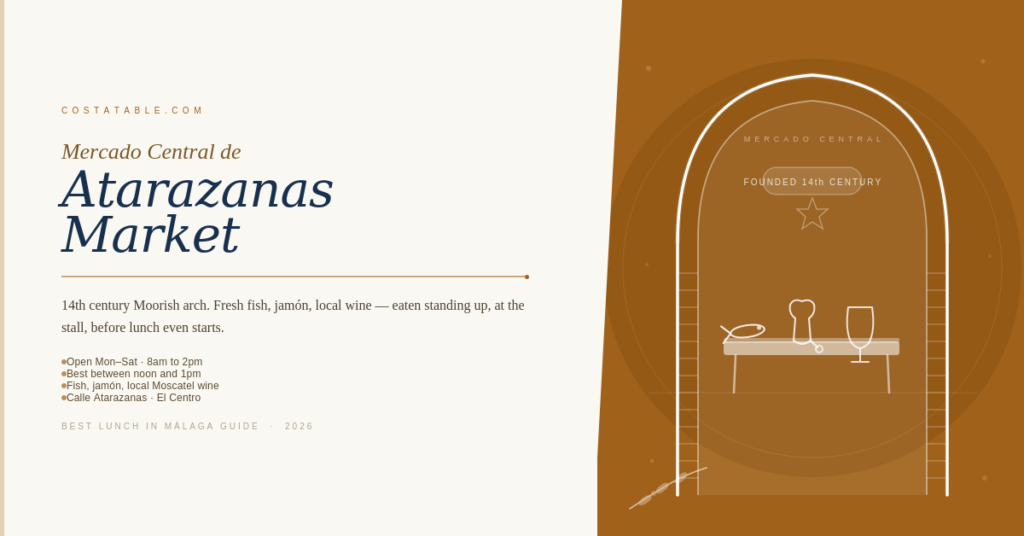
The Mercado Central de Atarazanas deserves particular attention for anyone eating lunch in Málaga. The market operates in the morning (roughly 8am to 2pm on weekdays, closing earlier on Saturdays), and the stalls selling prepared food begin winding down around 1:30pm.
If you arrive at the market between noon and 1pm, you can eat extraordinarily well for very little. The fish stalls near the back of the market sometimes serve small portions of the day’s catch — fried to order, eaten standing at the stall. The jamón stalls sell sliced meat by weight. Several stalls have bar counters where you can get a glass of local wine and something to eat alongside the morning’s shopping.
The building itself — a 14th century Moorish arch serves as the main entrance, converted into a market in the 19th century — is one of the more beautiful rooms in the city to eat in. Most people walk through without stopping. Do not do that.
After the market, the streets immediately surrounding it (Calle Atarazanas, Calle Especerías, and the small lanes feeding into them) are where to find traditional tapas bars doing good lunchtime trade. These are not places that appear prominently in travel guides. They are full of people who work nearby and eat here most days.
Practical notes on lunch in Málaga
Coffee and a pastry — not lunch yet
- Kitchens are not running at noon regardless of what the sign on the door says
- Most menú del día service does not start until 1:30pm
- If you are hungry, eat something small at a café and wait
Walk to your restaurant — kitchens opening
- Menú del día service begins — first orders being taken
- Good time to arrive if you want a relaxed start before the rush
- At the Atarazanas Market, stalls start winding down around this time
Peak lunch hour — the city is eating
- Restaurants fill up. Good rooms are full by 2:15pm
- Kitchen is at full pace — this is when the food is best
- If you have not booked at a popular place, you will wait
Last orders for the menú del día
- Most kitchens stop taking menú orders around 3:30-4pm
- À la carte service often continues but at different pace and price
- If you are still at the table, nobody will rush you — stay
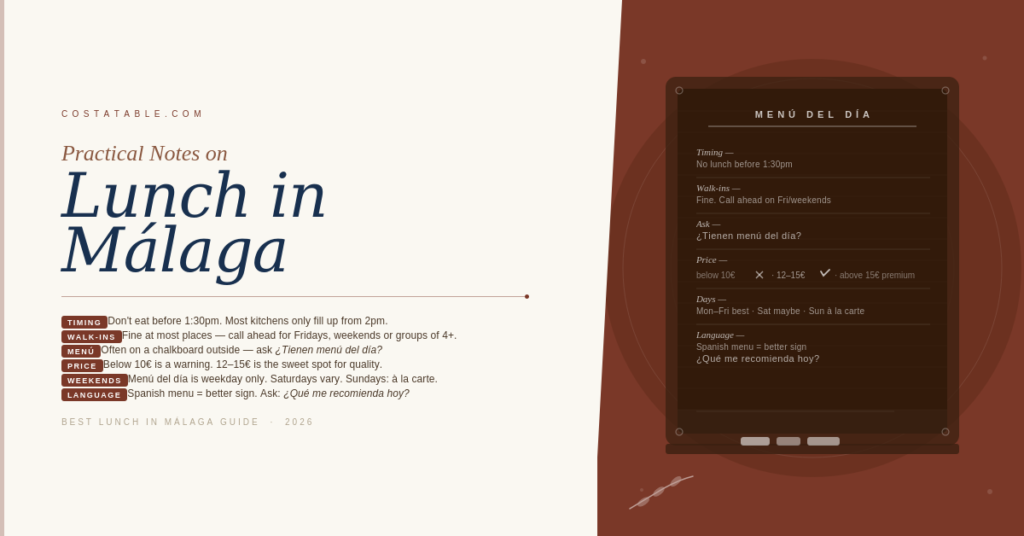
Walk-ins vs booking: For most casual and mid-range lunch places, walking in at 1:30pm or 2pm without a reservation is perfectly normal. For better restaurants, particularly on Fridays and weekends, calling ahead makes sense. Groups of four or more should always call.
The menú del día does not always appear on the website. Many traditional restaurants write the day’s menú on a chalkboard outside or hand it to you as a separate piece of paper. If you do not see it listed, ask — ¿Tienen menú del día? is enough.
Weekdays vs weekends: The menú del día is a weekday institution. Many restaurants do not offer it on Saturdays (some do, some do not) and almost none on Sundays. Weekend lunch at a restaurant in Málaga means eating à la carte, which is typically more expensive and often involves a longer wait.
Language: Menus in Spanish are almost always better than menus in English. If you cannot read Spanish fluently, asking the server what they recommend (¿Qué me recomienda hoy?) is a reliable approach at traditional places and usually results in something good.
The rest of the day
Lunch is one part of the Málaga eating picture. If you are planning a full day of eating, the best brunch spots in Málaga covers the morning, the best dinner restaurants in Málaga covers the evening, and the hidden gems guide covers the off-trail options across all mealtimes. The complete Málaga restaurant guide sits above all of these and gives a full overview of the city’s eating landscape.
Where to go from here
Every category of Málaga lunch has more depth than a single guide can cover. These are the supporting guides that go into specific detail:
- Best casual lunch in Málaga →
- Quick lunch spots in Málaga →
- Business lunch in Málaga →
- Stylish lunch venues in Málaga →
- Hidden lunch spots in Málaga →
Use these as the starting point. The city will do the rest.
Frequently asked questions
What time do restaurants serve lunch in Málaga? Most restaurants start their lunch service at 1:30pm, with kitchens fully operational by 2pm. The peak is between 2pm and 3:30pm. Many kitchens stop taking orders for the menú del día around 3:30-4pm, though à la carte service often continues later. Turning up before 1:30pm at most traditional restaurants will result in waiting.
How much does lunch cost in Málaga? The menú del día — two or three courses with bread and a drink — runs between ten and sixteen euros at most mid-range restaurants. À la carte at a traditional tapas bar, a full lunch of two or three dishes with a drink typically costs fifteen to twenty euros per person. At the better sit-down restaurants, expect to pay twenty-five to forty euros per person for a proper à la carte lunch.
What is the best area for lunch in Málaga? It depends on what you want. For the widest range of options including good menú del día restaurants, the area around Atarazanas Market and the streets just north of the Alameda Principal is hardest to beat. For seafood close to the beach, La Malagueta or Pedregalejo. For more contemporary cooking, Soho. For very cheap, very authentic, and almost zero tourists: El Palo, a bus ride east of the centre.
Is the menú del día available on weekends? Some restaurants offer it on Saturdays, but far fewer than on weekdays. Almost none offer it on Sundays. Weekend lunch in Málaga generally means à la carte, which is typically slower and more expensive. The best weekday menú del día spots often look quite different on a Sunday — smaller menu, higher prices, different atmosphere.
What dishes should I order for lunch in Málaga? The porra antequerana (cold tomato and bread soup) as a first course, followed by any of the local fried fish — boquerones fritos, dorada, or a mixed fritura malagueña — covers most of the city’s personality in a single meal. If you are eating near the market, the fresh clams (coquinas) or the day’s catch fried to order are worth prioritising over whatever you had planned.
Further reading

The menú del día is one of Spain’s great unsung institutions, and Málaga does it better than most cities its size. If lunch in Málaga has opened the door to eating seriously across Andalusia, there is plenty more to explore beyond the restaurant. For anyone spending time in the historic centre — where many of the lunch spots in this guide are located — understanding the neighbourhood itself adds a layer to the experience. The Málaga old town tour guide on Lifecosmo covers the streets, landmarks, and history of the quarter you will be walking through between meals, and pairs naturally with a day built around the Atarazanas Market and the Centro restaurants.
For transport, neighbourhood maps, and cultural context around the eating traditions covered in this guide, the official Málaga city tourism website fills in the practical gaps a restaurant guide deliberately leaves out.
Last updated: May 22 2026. Restaurant details, prices, and opening hours change — check current information before visiting.

Frank Petersen is co-founder of CostaTable and lives just outside Málaga, where everyday life naturally revolves around food, cafés, and local restaurants. With a strong interest in finding places that actually deliver - not just look good - he spends much of his time exploring both well-known spots and those that are easier to miss.
His focus is simple. To cut through the noise and highlight places that are worth visiting, whether it’s a relaxed brunch, a good coffee, or a dinner that feels right from start to finish.
Through CostaTable, Frank aims to give readers a more honest and useful guide to the food scene in Málaga, helping them spend less time searching and more time enjoying.