Best restaurants in Málaga – the complete local guide 2026
Málaga gets underestimated. For years it was treated as a transit stop – the gateway to the Costa del Sol that people flew into on a Friday afternoon and left the moment the beaches called.
That reputation stuck well past its sell-by date. The city has quietly, and then quite loudly, become one of the best places to eat in all of Andalusia. Maybe in all of Spain.
I have lived here for a couple of years now, originally from Denmark, and food was the thing that surprised me most when I arrived. Not pleasantly surprised in a vague, touristy way. Genuinely surprised – by the quality, the specificity of the local food culture, the directness of it. Espetos cooked over a wood fire on the beach. Anchovies so fresh they barely need cooking. Sweet local wine poured from barrels that have been in the same bar since 1840. A city that takes lunch seriously in a way that northern Europe simply does not.
This guide covers everything: where to eat brunch without queuing for an hour, the lunch spots that locals keep to themselves, the dinner tables worth booking weeks in advance, and the cafés where the coffee is genuinely worth slowing down for. If you are planning a trip or you already live here and want to eat better, this is the only reference you need.
Jump to a specific guide
This is the umbrella guide. Each section below links to a dedicated deeper guide for that topic or neighbourhood. Use these links if you already know what you are looking for:
Tapas bars – old townThe complete guide to tapas bars in the historic centre
Near the cathedralWhere to eat in the cathedral area specifically
Beach restaurantsChiringuitos, espetos and beachfront dining
Seafood restaurantsThe best fresh fish across the whole city
Soho neighbourhoodThe arts quarter’s best restaurants and cafés
La MalaguetaEating by the city’s closest beach
Marbella old townThe best restaurants an hour west
NerjaWhere to eat in Nerja on the eastern coast
FuengirolaThe honest guide to eating in Fuengirola
Why Málaga’s food scene hits different
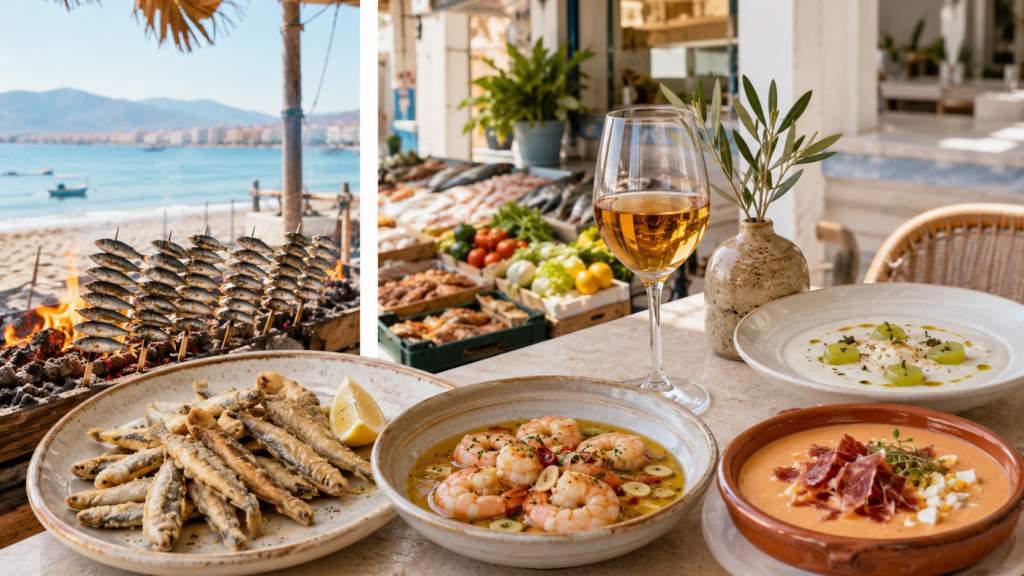
There is something particular about eating in Málaga that is hard to articulate until you have done it. The city sits at the intersection of a serious fishing tradition, centuries of Moorish culinary influence, and a newer generation of chefs who trained in the north – in the Basque Country and Catalonia – and came back home with different ideas.
The result is a food culture that does not feel like it is performing for tourists, even as the tourist numbers have grown. You still find old men standing at zinc counters at 8 in the morning eating boquerones en vinagre with their coffee. You still find markets where the fish arrived that morning and will be gone by noon. And you increasingly find restaurants where the cooking is genuinely inventive without being precious about it.
Seafood is the anchor. Espetos de sardinas – sardines skewered on bamboo canes and grilled over an open fire of olive wood right on the beach – is the dish that defines the city more than any other. You eat them at beachside chiringuitos, usually with your feet close to the sand, usually in the afternoon when the light is good. Do not skip them. This is non-negotiable.
Beyond the sardines: boquerones fritos (fried anchovies so fresh they barely need anything), gambas al pil-pil (prawns in furiously bubbling olive oil and garlic), porra antequerana (a thick, satisfying cold tomato and bread soup that beats gazpacho on texture alone), and ajoblanco (Málaga’s white gazpacho, made with almonds and grapes, shockingly good in summer). Sweet Málaga wine – Moscatel or the darker Pedro Ximénez – shows up in sauces and desserts and deserves a glass of its own.
The city also produces outstanding olive oil, almonds, avocados (the subtropical climate along the coast is perfect for them), and chivo malagueño – local kid goat, usually roasted and served simply.
Fun fact
The espeto de sardinas was invented on the beaches of Málaga in the late 19th century by a fisherman called Miguel Martínez Soler – known locally as El Bizco de la Playa. He cooked his daily catch over fires on the beach and sold it to passers-by. More than 130 years later the technique is completely unchanged: sardines on a sharpened bamboo cane, over a wood fire inside an old boat hull on the sand. In 2021 the espeto was officially declared an Intangible Cultural Heritage of Andalusia – the same protected status as flamenco. It is, as far as I know, the only beach food dish in Spain with that designation.
The lay of the land: where to eat by neighbourhood
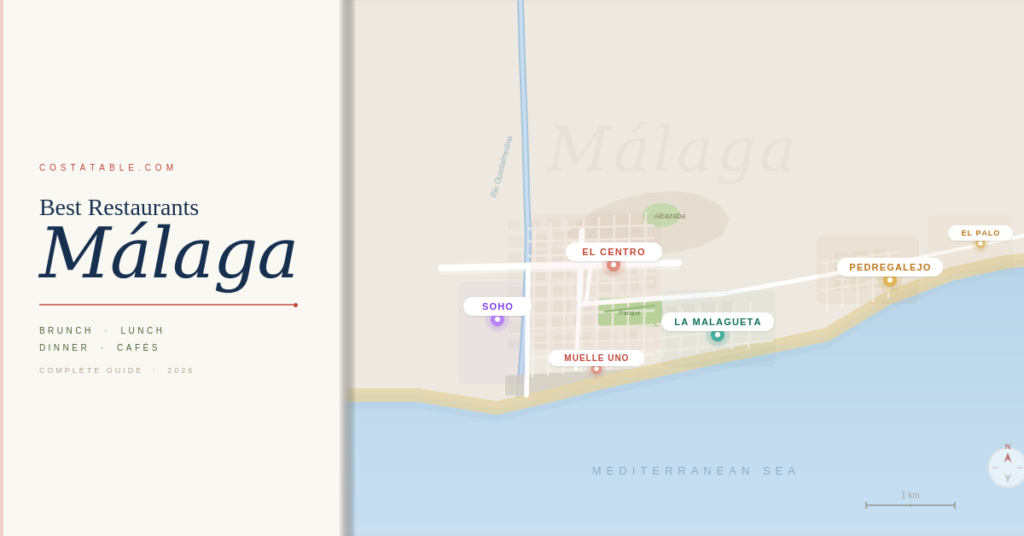
Understanding the geography helps. Málaga is not especially large, but each neighbourhood has its own eating personality.
El Centro is the historic heart – the Picasso Museum neighbourhood, the Cathedral, the Atarazanas Market. This is where you find the most tourist-facing restaurants alongside a handful of genuinely excellent places. The market itself is worth a morning: stalls selling fresh fish, jamón, fruit, and cheese. Buy something and eat it standing up. That is the correct way.
Soho (the arts district, south of the centre) is where younger, more experimental restaurants have set up over the last decade. Less formal, more interesting wine lists, chefs taking chances. It is the neighbourhood that gives the city its creative culinary reputation. Our dedicated guide to best restaurants in Soho Málaga covers the full neighbourhood in detail – from Balausta in the converted bishop’s palace to Byoko for brunch and La Deriva for the most honest budget lunch in the area.
La Malagueta, the beach neighbourhood closest to the centre, runs on chiringuitos and seafood restaurants. The quality varies enormously. Walk along the promenade and you will find tourist traps and genuinely excellent places side by side. El Balneario is the most established beachfront institution. Baluarte is the most accomplished and creative option for a sea view lunch. For the full breakdown, our guide to best restaurants in La Malagueta, Málaga covers every level from the beach chiringuitos to the top sit-down restaurants on the Paseo Marítimo.
Pedregalejo is further east along the coast – a former fishing village that still operates like one, at least gastronomically. This is the neighbourhood most locals will send you to for espetos. The beach here is narrow and the restaurants line it at close quarters. Go at lunch, stay through the afternoon.
El Palo is further still, and quieter, with some of the city’s best traditional seafood restaurants and almost no tourists. If you want to eat the way people who actually live here eat, El Palo is where to go. The chiringuito culture here is the most authentic on the entire coastline.
Fun fact
Pedregalejo and El Palo were entirely separate fishing villages from Málaga city until the 20th century, when urban expansion gradually absorbed them. They both retain their own distinct character – the narrow beach, the close-packed restaurants, the old boat hulls used as espeto fire containers. The residents here will tell you, often with some pride, that they are not quite from Málaga. They are from Pedregalejo or El Palo. That village identity is what preserves the food culture you find on the beach, and it is worth understanding before you go.
The old town around the Cathedral is the most concentrated area for tapas bars and traditional Andalusian restaurants. Our guide to best restaurants near Málaga Cathedral covers this specific area in detail – useful if you are spending the morning sightseeing and want to stay in the historic centre for lunch or dinner.
Best tapas bars in Málaga old town
The tapas culture in Málaga is built around the old town, and it is a specific culture with rules that are worth knowing. Unlike in Granada, tapas in Málaga are not free with drinks – you pay for them separately. But the quality at the better bars is consistently higher than the complimentary versions you get further inland, and the tapas bar scene in the old town is one of the most enjoyable ways to spend an evening in the city.
The principle of a good tapas evening in Málaga is movement. Two or three small plates per bar, then move on. Order a glass of wine or a caña at each place. Let the evening build momentum rather than trying to eat everything in one room. The best tapas crawl in the old town starts somewhere around Calle Granada or Calle Cárcer and moves as the mood dictates.
Nice to know
Tapas bars in Málaga old town start filling up from around 8:30pm and peak around 10pm. Arriving at 7pm means you will have a quiet room and staff who are still setting up. Arriving at 9pm means you will have the atmosphere that makes tapas bars worth going to. I know this feels very late for northern Europeans – I felt the same way when I moved here. After six months it feels completely natural and everything else starts to feel rushed.
The specific bars worth knowing about: Uvedoble Taberna for creative seasonal tapas and an excellent wine list; El Tapeo de Cervantes on Calle Cárcer for traditional Andalusian cooking done with real care; Bar Lo Güeno for the cheapest and most honest tapas experience in the centre; El Pimpi for atmosphere, Málaga wine and jamón in one of the city’s most distinctive interiors. Antigua Casa de Guardia on the Alameda is worth visiting specifically for the wine – poured from barrels since 1840, the staff mark your tab in chalk on the wooden counter. It is a completely different experience from anywhere else in the city.
Our dedicated guide to best tapas bars in Málaga old town covers ten specific recommendations in detail, including what to order at each one and practical advice on booking, timing and which streets to prioritise.
Best beach restaurants and chiringuitos in Málaga

This is where Málaga’s food identity is at its most distinctive. The chiringuito culture of El Palo and Pedregalejo – beach bars operating around a wood fire, serving espetos and fried fish to locals who have been coming to the same table for twenty years – is genuinely unlike anything you will find in most European cities.
The principle is simple. Walk east along the beach promenade from La Malagueta, or take bus 11 from Alameda Principal. Look for the column of smoke rising from the beach. Find a chiringuito with locals eating at it and a short menu on a chalkboard. Sit down. Order espetos and pescaíto frito and cold wine. Stay for two hours. That is the best value, most satisfying, most specifically Málaga meal you will eat on this coast.
Fun fact
El Tintero in El Palo is one of the most distinctive restaurants on the Costa del Sol. It operates on the subasta system – waiters walk around the packed tables carrying plates of freshly cooked seafood, shouting out what they have. You intercept the ones with what you want, take the plate and pay at the end based on how many plates are stacked on your table. This format comes directly from how fish was sold on the beach itself in the early 20th century – directly from the boats, in real time, to whoever wanted it. El Tintero turned that into a restaurant concept and has been doing it for decades. Nothing else works quite like it anywhere on this coast.
Beyond the chiringuito experience, the beach neighbourhood has proper sit-down restaurants that are worth knowing about. El Cabra in Pedregalejo is the most reliable for consistent quality and honest prices. Marisquería El Caleño is the most serious marisquería on this stretch of coast – proper shellfish, good rice dishes, excellent gambas a la plancha. Baluarte in La Malagueta is the best option when you want a genuine sea view with cooking that goes beyond the standard beach restaurant formula.
For the full guide to every level of beach eating in the city, our dedicated article on best beach restaurants in Málaga covers everything from a five-euro espeto at a plastic table to a special occasion lunch at a proper beachfront restaurant with a wine list.
Best seafood restaurants in Málaga
Málaga has been a fishing port for thousands of years and the relationship between the city and its fish runs through everything – the market, the chiringuitos, the old-town bars where boquerones fritos appear on almost every table regardless of what else anyone has ordered.
The best seafood in the city is almost always the simplest. A genuinely fresh dorada grilled with good olive oil and sea salt needs nothing else. The boquerón – the fresh anchovy – either fried until it crackles or marinated overnight in vinegar with garlic – is the defining flavour of this coast. The espeto is the technique that most honours the fish, because it does so little to it.
Nice to know
The Mercado de Atarazanas in the old town is worth a morning visit specifically for the seafood bars inside and around it. Fresh anchovies fried right next to the stall they came from. Coquinas (tiny clams) in garlic and white wine. Cold shellfish with cold white wine. The building itself – a 14th century Moorish archway forming the main entrance of a 19th century iron market hall – is extraordinary. Go before noon on a weekday for the best selection. On weekends it gets crowded to the point of losing some of its charm, though the building is worth seeing regardless.
For the complete guide to where to eat seafood across the whole city – from the market bars in the old town to the marisquerías of Pedregalejo to the beach chiringuitos of El Palo – see our dedicated guide to best seafood restaurants in Málaga. It covers every level of the market and gives honest notes on what to order, when to go and what makes the difference between a genuinely fresh seafood meal and a disappointing one.
Best restaurants in Soho Málaga
Soho is the part of Málaga I am most interested in right now. Ten years ago it was a run-down industrial area south of the Alameda. Now it has some of the most creative restaurants in the city, a street art scene that is worth spending an afternoon with, and the CAC Málaga contemporary art museum (free entry, genuinely good) as its cultural anchor.
The restaurants that have opened in Soho over the last decade have chosen the neighbourhood deliberately rather than ending up there by default. That tends to produce a different kind of place – more committed to what it is trying to do, more interesting in its references, less likely to be running on tourist footfall alone.
Fun fact
Málaga’s Soho neighbourhood adopted the name deliberately in the early 2010s as part of a regeneration strategy to attract creative businesses and restaurants to what had been a neglected industrial area. The name is a direct reference to the Soho districts in London and New York – creative, mixed-use neighbourhoods where art, food and independent businesses coexist. The CAC Málaga, which opened in 1999 in a converted 19th century wholesale market building, was the anchor that started the transformation. Today the neighbourhood has more than 50 large-format street murals commissioned from international artists, and the combination of the street art and the restaurant scene makes it the most interesting half-day in the city that most visitors never take.
The places to know in Soho: Balausta (technically on the edge of the old town, inside the Palacio del Obispo) for the most beautiful courtyard setting in the city and cooking that genuinely justifies the occasion; El Gastronauta for creative tapas at honest prices; Byoko for the best brunch in the neighbourhood; La Deriva for the most reliable menu del día if you want a good lunch without spending much; Bloom Málaga for groups who need a space that accommodates everyone. For the full picture, our guide to the best restaurants in Soho Málaga covers all of these in detail with honest notes on what works and what to order.
Best restaurants in La Malagueta
La Malagueta is the neighbourhood that connects the old town to the beach. It is where the Paseo Marítimo starts properly, where the promenade stretches east towards Pedregalejo and where most visitors have their first encounter with what eating by the sea in Málaga actually means.
The quality here varies more than in any other neighbourhood in the city. Right next to an excellent restaurant you will find a tourist trap – same view, same terrace, completely different kitchen. The skill is telling them apart before you sit down, which is why a little research before you arrive makes a significant difference.
Nice to know
La Malagueta faces almost due south, which means the best light on the sea is actually in the late afternoon rather than at sunset – the sun sets behind the hills to the west of the city, not over the water. If you are timing a lunch or dinner for the best visual experience of the promenade and the Mediterranean, aim to arrive around 4pm to 6pm on a clear day. The light on the water at that time is extraordinary and makes even a middling restaurant feel worth the trip.
The best options in La Malagueta: El Balneario for the most established and formally correct beachfront seafood experience in the neighbourhood – white tablecloths, proper service, a menu that has not needed to change because it was right to begin with; Baluarte for the most accomplished cooking and the best sea view terrace; La Farola del Mar for a casual, honest and affordable lunch option when you do not want to think too hard. Our guide to best restaurants in La Malagueta, Málaga covers all of these in detail and explains what each one is best for and when to go.
Brunch in Málaga

Málaga brunch exists in a slightly different register than you might expect. The city is not naturally a brunch town – this is a culture built around coffee and tostadas at 8am and lunch at 2:30pm. But a genuine brunch scene has grown, particularly in Soho and the centre, and it is worth knowing where to find it.
The good places tend to serve until 1pm or so, offer proper egg dishes alongside the Andalusian staples, and have coffee programmes that take the bean seriously. The less good places offer you an avocado toast photographed under ring lights for fifteen euros and a watery flat white.
Our full guide to the best brunch in Málaga covers the top picks in detail. A few things worth knowing before you go: booking is often unnecessary before 10am but increasingly useful after 11am on weekends. Many of the better spots are small – twenty covers, sometimes fewer. Show up early or plan ahead.
If you are specifically after a leisurely mid-morning experience with table service and something closer to a full spread, the guide to where to eat brunch in Málaga covers the options neighbourhood by neighbourhood, which helps if you are already based in a particular part of the city.
For those watching a budget without sacrificing quality, Málaga does this well – the cheap brunch options in Málaga prove that eating well before noon does not require spending much. The city’s café culture means you can get a genuinely excellent breakfast for three or four euros if you know where to look.
The city also caters well to the later riser. Several spots take late brunch seriously – running their brunch menu until 2pm or even 3pm on weekends. For those who like their eggs Benedicts with a view, the rooftop brunch options give you the Centro skyline alongside your coffee. And if the setting matters as much as the food, the guide to stylish brunch spots in Málaga covers places where the room is part of the experience.
Lunch in Málaga
Lunch is the serious meal. This is Spain. If you treat dinner as your main event and lunch as an afterthought you will miss the way the city actually operates. The menú del día – a set two or three course lunch served between roughly 1:30pm and 4pm – is one of the great underrated institutions of Spanish eating life. You get a starter, a main, bread, often a drink and a dessert, for somewhere between ten and sixteen euros. The quality at good restaurants is not a lesser version of the à la carte menu. It is often the same kitchen doing what it does best, just at speed and for a fixed price.
Fun fact
The menú del día was introduced across Spain as a labour law requirement during the Franco era, designed to ensure working people had access to a subsidised midday meal. The original intention was purely economic. But the format became so deeply embedded in Spanish food culture that it has outlasted its origins by decades, and at a good local restaurant in Málaga it remains one of the best value eating options anywhere in Europe. The quality at a well-run local restaurant with a daily menu is consistently higher than what you get from the tourist-facing à la carte options at similar prices – because the local workers who eat it every day will stop coming the moment it stops being worth it.
For a comprehensive overview of where to eat well at midday, the top lunch spots in Málaga covers the range from market-adjacent places to proper sit-down restaurants with interesting menus.
The casual end of the lunch market deserves its own attention. Some of the best meals in the city happen in places without tablecloths – neighbourhood restaurants that have been doing the same thing for decades and have got very good at it. The best casual lunch options in Málaga focuses on exactly these: the bodega where the owner knows everyone’s name, the tapas bar where you stand at the counter and point at the dishes under glass.
Málaga also functions increasingly well as a city for business travel, and the business lunch spots cover places with private dining areas, quieter rooms, and menus that do not require explaining to a client. For something more aesthetically considered – high ceilings, thoughtful plating, wine lists that have been curated rather than assembled – the stylish lunch venues are worth knowing about.
If time is the issue – a quick break between museums, or a working lunch that needs to be over in forty-five minutes – the best quick lunch spots in Málaga are genuinely quick without being bad. This is harder to achieve than it sounds.
And if you prefer to eat away from the tourist trail entirely, the hidden lunch spots cover places the average visitor never reaches. These tend to be in residential streets, signed modestly, and full of people who work nearby. The food is almost always better for the lack of a tourist audience.
On the Atarazanas market
Worth a standalone mention: the Mercado Central de Atarazanas is not just a place to buy ingredients. Several of the market stalls serve food standing up or on stools – prawns, oysters, fried fish, jamón. Go on a weekday morning. On weekends it gets crowded to the point of losing its charm, though even then the building itself – a 14th century Moorish arch forms the main entrance – is worth seeing. Eat something, then pick up some almonds or local honey to take home.
Dinner in Málaga

Dinner in Málaga happens late. Restaurants generally open around 8:30pm or 9pm, filling up properly around 10pm. If you show up at 7:30pm, you will have the room to yourself and slightly puzzled staff. If this timing is a problem, a few of the more tourist-oriented places open earlier, but the experience is not the same.
The best dinner restaurants in Málaga covers the full range – from traditional Andalusian cooking to contemporary tasting menus. What they share is that they take dinner seriously. This is not a city where fine dining means pretension; it tends to mean proper technique applied to exceptional local ingredients, served without ceremony.
Romantic dinner options are genuinely good here. The setting helps – this is a city with a historic centre that has been beautifully maintained, with old buildings converted into restaurant spaces that feel like secrets. The romantic dinner guide covers candlelit rooms in converted townhouses, terraces overlooking the Cathedral, and small tasting menu restaurants with a personal feel.
For those specifically seeking high-end cooking – multi-course menus, serious wine pairings, chefs pushing what Andalusian cuisine can be – the fine dining options in Málaga are worth the research. The city has a small number of restaurants operating at this level, and they are better than their relative obscurity suggests.
The light at the end of a Málaga day is extraordinary. From about an hour before sunset the sky goes through shades that seem almost theatrical. Several restaurants have positioned themselves to make the most of this. The best sunset dinner spots includes rooftop terraces and cliff-edge restaurants where the view is genuinely part of the meal, not just a backdrop for photos.
Not every dinner needs to be an occasion. The casual dinner options cover places where you can eat well in jeans, without a booking, without spending a lot. Some of the most satisfying dinners in the city happen at chiringuitos that stay open through the evening, or at neighbourhood tapas bars where you stand at the bar and let the bartender make decisions for you.
For those who want to eat well away from the more well-trafficked streets, the hidden dinner restaurants are worth seeking out. These are the places that locals guard slightly jealously – well-reviewed among people who know the city, invisible to the standard tourist itinerary. The reward for finding them is almost always a better meal at a lower price than anything on the main tourist circuit.
On eating tapas
Tapas culture in Málaga is different from what you might find in Madrid or Barcelona. In Málaga, many traditional bars still give you a small free tapa with every drink ordered. It is not universal, and it is more common at older, traditional bars than at newer ones – but when you find it, it changes the arithmetic of eating completely. The practice varies: sometimes it is a small dish of olives or potato chips, sometimes it is something more substantial – a small portion of stew, a piece of fried fish, a croqueta. The tradition is strongest in El Palo and some of the older parts of the centre. Ask at the bar rather than assuming.
Cafés and coffee in Málaga
Málaga takes coffee seriously in its own particular way. The city has its own coffee vocabulary that trips up visitors who assume they know how to order: café con leche here typically means espresso with warm milk. But there is a whole graduated system – solo (straight espresso), nube (mostly milk, tiny coffee), sombra (mostly milk), mitad (half and half), corto (short, strong), largo (longer pull, more water) – and locals order with precision.
Fun fact
Málaga has its own coffee ordering system that is unique in Spain. The different ratios of milk to coffee each have a specific name – from sombra (mostly milk, a shadow of coffee) through mitad (half and half) to solo (straight espresso with no milk at all). The system developed in the city’s traditional coffee bars over generations and locals order with the kind of precision that confuses visitors from other Spanish cities as much as it confuses northern Europeans. If you just ask for a café con leche, you will get something. But if you know the system, you can get exactly what you actually want.
The third-wave coffee movement has arrived in the city, and there are now several places with serious extraction equipment, single-origin beans, and baristas who have trained properly. These coexist with the traditional cafés where the coffee is made on an old La Cimbali machine and the milk has been frothed the same way since the 1980s. Both are worth knowing about and both are worth trying.
The best cafés in Málaga covers the full range – from traditional old-city spots with marble counters and tostadas con aceite, to the newer wave of specialty coffee shops that have opened in Soho and the surrounding streets. For those whose priority is the bean itself – the roast, the extraction, the origin – the best coffee in Málaga focuses specifically on specialty cafés where craft is taken seriously.
One tradition worth experiencing regardless of whether you are a coffee person: the Málaga breakfast. Tostada (thick toasted bread) with aceite y tomate – olive oil and crushed tomato rubbed directly onto the bread – and a café con leche. It costs almost nothing at a traditional bar, takes about fifteen minutes, and sets the day up perfectly. It is one of those small, specific pleasures that you find yourself craving months after you get home.
Hidden gems and insider eating

Every city has a tourist layer and an underneath. The underneath of Málaga is particularly worth finding. The guide to hidden gems in Málaga covers the restaurants and bars that do not advertise, do not show up prominently in the obvious review sites, and exist primarily because locals like them.
A few principles for finding your own hidden places: walk away from the obvious tourist streets and keep walking. If a restaurant’s menu is in four languages and a host is standing outside inviting you in, keep walking. Look for handwritten menus, full rooms at the local eating time (2pm for lunch, 10pm for dinner), and a wine list that includes regional Spanish wines rather than just the international standards.
The old parts of the Lagunillas and Cruz de Humilladero neighbourhoods reward exploration. Neither is pretty in a postcard sense, but both have old-school bars and restaurants that have been feeding the neighbourhood for generations. The food is honest, seasonal, and often very good.
Best restaurants in the wider Málaga region
Málaga city is the obvious starting point but the province extends east and west along the coast with several towns that are worth visiting specifically for the food, or that you will pass through on a longer trip along the Costa del Sol. Each of the following towns has a dedicated guide on this site with honest, specific recommendations.
Marbella old town
About an hour west of Málaga by car or bus, Marbella’s Casco Antiguo has the best restaurant scene of any town on the western Costa del Sol. It has two Michelin-starred restaurants – Skina and Messina – alongside some genuinely excellent mid-range and budget options including Taberna La Niña del Pisto for the best creative tapas in the old town and Bar Altamirano for the most honest cheap lunch you will find in the area. The whitewashed streets, the orange tree square and the concentrated quality of the Casco Antiguo make it one of the most rewarding eating destinations on this coast.
Nice to know
Marbella old town is very different from the Golden Mile and Puerto Banús that dominate most people’s image of the town. The Casco Antiguo is a genuinely beautiful historic centre – whitewashed buildings, narrow streets, the famous Plaza de los Naranjos with its orange trees – that predates the resort era by several centuries. The restaurants here compete on quality rather than location, which keeps the standard relatively high. If you have dismissed Marbella as a celebrity resort destination, the old town deserves a second look specifically for the food.
Our full guide to the best restaurants in Marbella old town covers the full range from the cheapest local bars to the most celebrated fine dining in the region, with honest notes on each one and practical advice on booking and timing.
Nerja
About an hour east of Málaga along the coast, Nerja has managed to stay charming despite significant visitor numbers. The Balcón de Europa gives it one of the most dramatic viewpoints on the whole coast. The restaurant scene – particularly Ayo’s beach paella on Playa de Burriana (one of the most famous chiringuito experiences on the entire Costa del Sol) and the creative cooking at Restaurante Oliva for a romantic dinner – makes it a genuinely worthwhile eating destination rather than just a sightseeing stop.
Fun fact
The Balcón de Europa in Nerja was named by King Alfonso XII during a visit in 1885, following a series of devastating earthquakes that destroyed much of the town. He stood on the old fortress promontory overlooking the sea and called it the balcony of Europe. The name has stuck ever since. The restaurants immediately surrounding the viewpoint are the most visited in Nerja – and some of them are very good – but the best eating in the town is almost always found one or two streets further back, in the side streets where the prices are lower and the local crowd is larger.
Our guide to best restaurants in Nerja covers everything from the most famous chiringuito on the Costa del Sol to the quietest local tapas bars, with the same honest format as everything else on this site.
Fuengirola
Fuengirola is about 30 kilometres west of Málaga and easy to reach by train in 45 minutes. The food scene here is more interesting than the package holiday reputation suggests – but you need to know where to look. The key is going to Los Boliches, the neighbourhood east of centre, for the chiringuito culture and the honest tapas bars like Bar Los Marinos. The old town area has some genuinely good local restaurants including Casa Garrido for the most reliable traditional Andalusian cooking in the town. The Cercanías train makes it easy to get there without a car and the journey is pleasant along the coast.
Nice to know
Los Boliches – the neighbourhood east of Fuengirola centre – takes its name from the boliches, the traditional net-fishing technique used by local fishermen to catch anchovies and sardines in the shallow coastal waters. The neighbourhood has retained a more genuinely local character than central Fuengirola, and the tapas bars and chiringuitos here draw a more authentic crowd as a result. It is about a 15-minute walk east along the promenade from Fuengirola centre – worth the walk for a significantly better eating experience than anything on the main tourist strip.
Our guide to the best restaurants in Fuengirola covers the full town with honest recommendations across every budget – from a €12 menu del día at a local bar to the best romantic dinner option the town has to offer.
📋 Day trips from Málaga – distances and travel times
| Nerja | 1hr 15min east by bus · Best for: beach paella at Ayo’s, Balcón de Europa sea view dining, Restaurante Oliva for dinner |
| Fuengirola | 45min west by Cercanías train · Best for: local tapas in Los Boliches, chiringuito beach lunch, budget eating |
| Marbella | 1hr west by bus · Best for: Michelin dining at Skina or Messina, old town tapas, the most beautiful old town on this coast |
| Frigiliana | 1hr 20min east + inland · Beautiful Moorish village above Nerja, excellent local wine, worth combining with a Nerja beach day |
Málaga wine – what to drink and where
Málaga has its own wine appellation – DO Málaga and DO Sierras de Málaga – and the local wine tradition is one of the oldest in Europe. The sweet Málaga Virgen wine, made from Muscat grapes, has been produced here since Phoenician times and is one of the most underrated wines in Spain. It is amber in colour, rich and complex without being cloying, and it pairs with local seafood in a way that surprises most people the first time they try it.
Beyond the sweet wines, the DO Sierras de Málaga appellation produces dry whites from Muscat and Pedro Ximénez grapes that are excellent with the local fish – clean, slightly mineral and genuinely refreshing in the heat. Several of the better restaurants in the city now stock wines from small local producers that are almost impossible to find outside the region. Worth asking about specifically when you are choosing wine at dinner.
The best place to experience Málaga’s own wine tradition is Antigua Casa de Guardia on the Alameda Principal. It has been there since 1840 and the wine still comes from barrels stacked behind the counter. Staff mark your tab in chalk on the wood. It is completely unlike any other bar in the city and is worth going to specifically for this experience rather than treating it as a convenient stop on the way somewhere else.
Practical notes on eating in Málaga
Timing: Breakfast runs 8am to 11am at most cafés. Lunch from 1:30pm to 4pm. The gap between lunch and dinner (4pm to 9pm) is aperitivo time – a beer, a glass of wine, some olives. Dinner from 9pm onwards, with the city filling up properly around 10pm. Adjust your expectations of hunger accordingly.
Booking: Necessary for the better dinner restaurants, especially on weekends. Increasingly useful at brunch spots on Saturday and Sunday mornings. Usually unnecessary for lunch at mid-range and casual places. Always call rather than emailing – response rates to emails at Spanish restaurants can be unreliable.
Payment: Most restaurants accept cards now, but carry some cash for traditional bars, market stalls, and chiringuitos on the beach. Some older places still prefer it, and a few still only take cash.
Language: Menus in Spanish are almost always a better sign than menus in five languages. If your Spanish does not extend to ordering confidently, pointing at a dish on another table is completely acceptable. Most owners and staff in this city have been feeding confused foreigners for long enough to be patient about it.
Seasons: Summer (July to August) is crowded, hot, and slightly manic. The best time to eat in Málaga is probably late spring (April to June) or early autumn (September to October), when the weather is excellent, the tourists have thinned, and the seasonal ingredients – early summer tomatoes, autumn seafood – are at their best. The city also eats very well in winter: quieter, easier to get a table, and the hearty stews and roasted meats that come out of Andalusian kitchens in cold weather deserve to be better known.
What to drink: Málaga wine – the sweet Moscatel varieties and the dark, raisiny Pedro Ximénez – is what the region produces and what you should drink. For table wine, the wines of nearby Ronda (an hour into the hills) are worth knowing: serious red and white wines that remain underpriced relative to their quality. For beer, local cerveza on draught is the standard and it is fine.
Where to start

If this is your first time eating seriously in Málaga, a sensible approach: one morning at a proper café for breakfast (tostada, aceite, café con leche), one lunch at a market-adjacent traditional restaurant for seafood, one evening at a chiringuito in Pedregalejo for espetos at sunset, and one dinner reservation at one of the city’s better restaurants. That four-meal sequence covers the city’s personality better than any amount of planning.
Then work outward from there, using the individual guides to find the specific experience you are looking for. The guides below cover each mealtime in depth:
- Best brunch in Málaga
- Best lunch spots in Málaga
- Best dinner restaurants in Málaga
- Best cafés in Málaga
- Hidden gems in Málaga
The city has more good places to eat than any single guide can cover. Use these as starting points and let the city surprise you from there.
Frequently asked questions
Common questions about eating in Málaga answered honestly.
01 What is the most famous food in Málaga? ⌄
Espetos de sardinas – sardines grilled on bamboo skewers over olive wood fires on the beach – is the dish most associated with the city. It was invented in Málaga in the late 19th century and was declared an Intangible Cultural Heritage of Andalusia in 2021. Boquerones (anchovies, either fried or marinated in vinegar) are a close second. For something sweet, the local Moscatel wine and bienmesabe (an almond cream dessert) are distinctly Malagueño. The porra antequerana – a thick cold tomato and bread soup – is the local version of gazpacho and is significantly better on texture.
02 What are the best restaurants in Málaga old town? ⌄
The best restaurants in Málaga old town include Uvedoble Taberna for creative seasonal tapas and an excellent wine list, El Tapeo de Cervantes on Calle Cárcer for traditional Andalusian cooking done with genuine care, Kaleja for a romantic dinner with precise and accomplished cooking, El Pimpi for atmosphere and Málaga wine in the city’s most distinctive bar interior, and Bar Lo Güeno for the cheapest and most honest tapas experience in the centre. Our dedicated guide to best tapas bars in Málaga old town and best restaurants near Málaga Cathedral cover these in much more detail.
03 Is Málaga expensive for food? ⌄
It depends entirely on where you eat. At the traditional end – tapas bars, market counters, chiringuitos – Málaga is one of the more affordable cities in Spain. A plate of espetos costs €5 to €7. A menu del día at a good local restaurant is €10 to €14 including a drink. A full tapas evening for two at some of the best bars in the old town costs €30 to €50 including wine. At the high-end restaurant level, prices are comparable to other Spanish cities. The menú del día remains one of the best value eating propositions in Europe.
04 What neighbourhood has the best restaurants in Málaga? ⌄
For variety and quality right now, the area around Soho and the southern Centro has the highest concentration of interesting restaurants. For traditional seafood, Pedregalejo and El Palo on the eastern coast are where locals go. El Centro has the widest range of everything. La Malagueta is the best option if you want to combine a sea view with the meal. Each neighbourhood has a dedicated guide on this site – use the links at the top of this page to go directly to the area you are interested in.
05 When should I book restaurants in Málaga? ⌄
For dinner at better restaurants: book at least a week ahead, more for weekends in summer. For the sea view terraces at La Malagueta restaurants like Baluarte and El Balneario: book two to four days ahead on weekdays, a week or more for summer weekends. For brunch at popular spots: book two to three days ahead for weekends. For lunch: usually not necessary at most places, but worth calling ahead for groups of four or more. The general rule is: the better the restaurant and the better the table, the earlier you need to book in summer.
06 Are tapas free in Málaga? ⌄
In Málaga you pay for tapas separately from your drinks – they are not included free the way they are in Granada. This is simply how tapas culture works in this city. The trade-off is that the tapas are generally of higher quality and more carefully prepared than the complimentary versions in Granada. At some of the older traditional bars in El Palo and parts of the centre, small free tapas still arrive with drinks – but this is increasingly rare rather than standard. Ask at the bar if you are unsure rather than assuming it will happen.
07 Can I find good vegetarian food in Málaga? ⌄
Increasingly yes, particularly in Soho and at newer restaurants. Traditional Andalusian cooking is meat and fish heavy, but the city’s evolving restaurant scene has adapted well. The best vegetarian options tend to be at restaurants with a modern or contemporary Spanish menu rather than traditional tapas bars, which can have limited vegetarian choices. The brunch and café scene in Soho is particularly good for vegetarian eating – Byoko and several of the other newer cafés in the neighbourhood have menus where vegetarian dishes are not an afterthought.
08 What is the best day trip from Málaga for food? ⌄
For a day trip specifically focused on food, Nerja is the best option. The combination of the Nerja Caves in the morning (genuinely worth seeing), a long beach paella at Ayo’s on Playa de Burriana for lunch, and a walk around the Balcón de Europa in the afternoon is one of the best-structured food days on the Costa del Sol and costs almost nothing. Marbella old town is the best option if you want a more restaurant-focused day with a higher-end dinner at Skina or Messina as the centrepiece. Fuengirola is the easiest option if you are on a budget and just want a good chiringuito lunch without the journey.
Further reading
Málaga rewards the curious eater. The more you dig, the better the meals get. If you are planning time on the Costa del Sol and want to eat well beyond the obvious options, two resources are worth bookmarking.
For a wider perspective on dining and travelling through Spain, restaurant and travel stories from across Spain on Lifecosmo covers experiences from regions that pair naturally with a Málaga trip – especially useful if you are combining the coast with time in Seville, Granada or further north.
For transport, cultural itineraries, and neighbourhood context that a restaurant guide deliberately leaves out, the official Málaga city tourism website fills in everything else you need to plan a visit properly.

Frank Petersen is co-founder of CostaTable and lives just outside Málaga, where everyday life naturally revolves around food, cafés, and local restaurants. With a strong interest in finding places that actually deliver - not just look good - he spends much of his time exploring both well-known spots and those that are easier to miss.
His focus is simple. To cut through the noise and highlight places that are worth visiting, whether it’s a relaxed brunch, a good coffee, or a dinner that feels right from start to finish.
Through CostaTable, Frank aims to give readers a more honest and useful guide to the food scene in Málaga, helping them spend less time searching and more time enjoying.