Every city has a tourist layer and an underneath. In Málaga the gap between the two is wider than you might expect. The restaurants at the top of every list are not necessarily the best ones – they are simply the most visible. The places that show up in every travel guide exist in a kind of feedback loop: they get recommended, so they get visited, so they get recommended again. Eventually the room is full of people who found it the same way you did, and the thing that made it good in the first place has been quietly replaced by the business of being busy.
The places in this guide work differently. They are not hiding exactly – they are just not trying very hard to be found. Some are a street or two off the obvious routes. Some have been here for decades and have never needed a marketing strategy. Some are newer and have grown entirely through people coming back and bringing someone with them.
What they share is specificity. Each one does something particular and does it well. That is usually enough, in a city like Málaga, to build a loyal room.
Why Málaga rewards slower exploration
Málaga is not a city you exhaust in two days. The historic centre alone – the Atarazanas Market, the streets around the Cathedral, the Soho arts district to the south, the old fishing neighbourhoods east along the coast — contains more good eating than any single visit can cover. But the good places are not evenly distributed. They cluster in certain streets, certain neighbourhoods, at certain times of day.
The principle for finding them is simple enough: walk away from the obvious. If there is a host standing outside inviting you in, keep walking. If the menu is laminated and translated into four languages with photos, keep walking. Look instead for rooms that are full of people who work nearby, menus on a blackboard that change during the week, and prices that have not been adjusted upward to account for tourists.
The hidden gems here split naturally across the different parts of the day — cafés for morning and afternoon, restaurants for lunch and dinner. The lunch and dinner recommendations overlap with the hidden lunch spots guide and the hidden dinner guide, which go deeper on each. This page gives you the full picture across all mealtimes.
Hidden Cafés and Coffee Spots
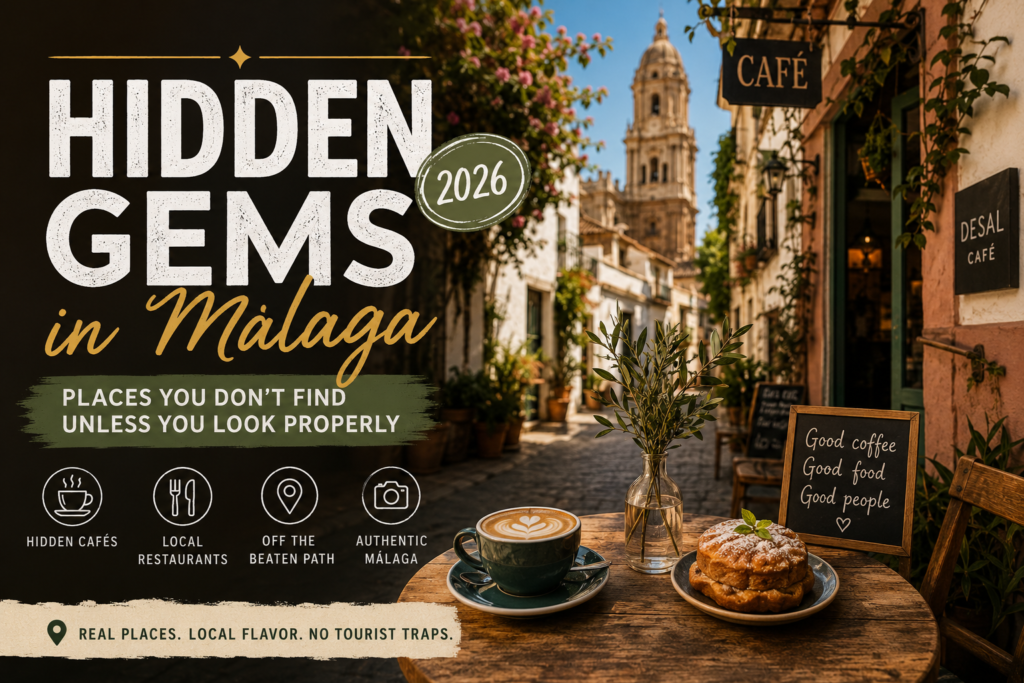
Desal Café
Desal is one of those cafés that takes a couple of visits to properly understand.
The first time you walk in, nothing announces itself.
he room is calm, the pace is unhurried, and it is easy to underestimate how much thought has gone into making it feel that way.
The coffee is consistent – properly extracted, not the dark-roasted bitter version that passes for espresso at most bars in the centro – and the food follows the same logic. Simple things done properly.
A good tostada, a pastry worth eating, seasonal specials that suggest someone is actually thinking about what to put on the menu.
What makes Desal worth returning to is its reliability. It does not have good days and bad days in the way that more ambitious places sometimes do.
You know what you are going to get and it is always worth getting. It is also one of the few cafés in Málaga where sitting alone does not feel awkward. Laptops, books, long coffees — all fine. The staff are present without being intrusive, which is harder to pull off than it sounds.
Mia Coffee Shop

Mia is smaller and quieter than most places you will find in the centro, and that is the point. It is not built for big groups or quick turnovers. It is built for people who want to pay attention to what they are drinking.
The coffee programme is more considered than average – there is genuine thought behind the sourcing and the extraction – and the space supports that focus by keeping everything else stripped back.
Simple seating, low noise levels, no music loud enough to make conversation difficult.
It is worth noting that Mia has not tried to expand or replicate itself. It is still the small, focused place it was when it opened.
In a city where every successful café eventually becomes a chain or a brand, that restraint is worth something.
Kima Coffee
Kima represents a newer wave of Málaga coffee culture.
The approach here is clean and technically precise – you can taste the difference between the different origins they serve, and the baristas actually know what they are doing rather than just operating equipment.
The space is modern but comfortable, and it has not yet reached the critical mass of popularity that kills the atmosphere at places like this.
You can still get a table without effort and drink your coffee without raising your voice.
The specialty coffee scene in Málaga is covered in more depth in the best coffee guide for Málaga, which puts Kima alongside the other serious coffee spots in context.
Bertani Café
Bertani is deliberately small and deliberately focused.
It does not try to be a brunch destination or a lunch spot. It is a café that does coffee well in a room that encourages you to slow down.
The quality is stable across visits – no big surprises, no disappointing days – and the space, while compact, is comfortable enough to stay in longer than you planned.
It works best for solo visits or pairs.
If you are looking for somewhere to think, read, or have a conversation without shouting across a table, Bertani is more reliable than most options in the city centre.
RORO Café
RORO sits slightly outside the usual café categories. It is more relaxed about food than the pure coffee specialists, and more focused on coffee than a general café.
The combination of decent food, good coffee, and an atmosphere that does not demand anything from you makes it easy to stay.
You can come here mid-morning for a coffee and leave two hours later having eaten something and worked through a list without noticing the time passing.
The flexibility is the main thing.
RORO adapts to how you want to use it rather than imposing a format on you, and in a city with a lot of places that have a strong idea of what they are, that adaptability is quietly valuable.
La Recova
La Recova is different in character from the specialty coffee places. It is warmer, more traditional, and more deeply connected to Málaga’s existing café culture than to anything that has arrived in the last decade. The setting feels lived-in rather than designed. The coffee is good in the honest, no-fuss way that Málaga’s traditional bars have always been good at it – not technically remarkable, but reliably satisfying.
Go here if you want to sit somewhere that feels like the city itself rather than like a café that could have opened in any European city in the last five years. It is a different experience and a valuable one.
Casa Aranda
Casa Aranda is not quite hidden – it is well known to locals and appears in enough places to have a reputation – but the experience it offers is so distinct from modern café culture that it belongs in this guide.
This is the old Málaga: louder, faster, more chaotic, and completely at home with itself. The churros and hot chocolate here are the benchmark against which everything else in the city is measured.
The room is always moving, the pace is relentless, and you eat standing up or perched on a stool in the narrow space.
It is not comfortable in a modern sense. It is comfortable in the way that places with their own established rhythm are comfortable – you step into something that already knows what it is doing and does not need your approval to keep going.
Hidden Restaurants
Uvedoble Taberna
Uvedoble does tapas properly, which means it does not reinvent them but gives them more attention than most places bother to.
The menu is focused — not long, not trying to cover everything — and that focus shows in the execution. Flavours are cleaner than average, portions are better proportioned, and the smaller room means you are eating closer to the kitchen, which changes the experience in ways that are hard to quantify but easy to feel.
It is primarily a dinner destination, and it works well for a long evening – order gradually, take your time, let the night build.
The pacing is not rushed, and the staff understand that a good dinner is not just about getting food to the table quickly.
The dinner silo on this site covers Uvedoble alongside other good dinner options.
If you are planning an evening in Málaga specifically, the best dinner restaurants guide is the starting point, with the hidden dinner spots guide going deeper on the off-trail options.
La Cosmopolita
La Cosmopolita sits somewhere between hidden and known.
It is not completely off the radar, but it is a step removed from the obvious tourist circuit, and the food justifies seeking it out. The focus here is on ingredients – what is good, what is in season, what the kitchen can do with it without overcomplicating the result.
There are no heavy sauces masking average produce.
What you taste is what it actually is.
The room is calm and organised without feeling stiff. Service is attentive without being theatrical. It is a good choice for lunch or dinner when you want something genuinely well-made without the ceremony of a tasting menu.
The top lunch spots in Málaga includes La Cosmopolita for its strong lunchtime menu and reliable kitchen.
Buenavista does not try to stand out, which is part of why it works. The menu mixes traditional and contemporary elements without pushing too hard in either direction, and the overall experience feels balanced rather than calculated.
You can come here for a quick dinner or stay for the whole evening and both work without feeling like you are doing the wrong thing.
The food is consistent. That sounds like a modest thing to say, but in a city with a lot of places that are good one visit and disappointing the next, consistency is worth a lot.
The staff are competent and relaxed, the room is comfortable, and the bill is reasonable for what you get.
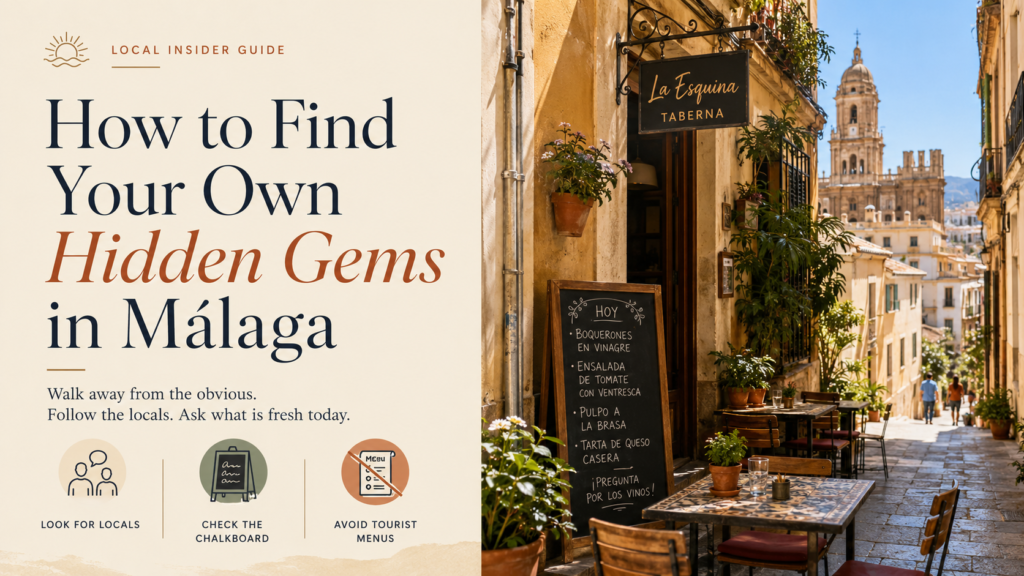
The places listed above are good. But the point of this guide is not to give you a list to tick off — it is to give you a method.
The method is simple. Walk away from the obvious streets.
Arrive at lunchtime (around 2pm) or dinnertime (around 9:30pm) and look for rooms that are full.
If the people eating there are clearly locals – if nobody is wearing a backpack, if the menus on the table are only in Spanish, if the conversation is in Andalusian rather than English – you are in the right place.
Ask the server what they recommend. In Spanish: ¿Qué me recomienda hoy? The answer at a good traditional restaurant will tell you exactly what is fresh and what the kitchen is proud of that day. Order that.
The full restaurant guide for Málaga gives the complete picture of the city’s eating landscape – pillar page, all silos, all mealtimes.
The brunch guide covers the morning in depth. The lunch guide covers midday including the menú del día. The café guide covers the coffee and café scene across all neighbourhoods.
Use these as starting points. Then let the city take over from there.
Frequently Asked Questions
What makes a restaurant a hidden gem in Málaga? Not just obscurity — plenty of bad places are obscure. A hidden gem is a place that is genuinely good and genuinely under-visited relative to its quality. In Málaga this usually means restaurants and cafés that do not appear prominently in standard tourist guides, are full of locals, and have been building their reputation slowly through repeat customers rather than through marketing.
Which neighbourhood has the most hidden gems in Málaga? El Palo and Pedregalejo along the eastern coast are the most consistently under-visited by tourists relative to quality. The streets around the Atarazanas Market in El Centro — one or two blocks off the main tourist routes — also have a cluster of traditional tapas bars that rarely appear in guides. In Soho, the smaller streets running parallel to the main gallery strip have several good cafés and restaurants that get overlooked.
Are hidden gem restaurants more affordable in Málaga? Usually yes. Places that have not positioned themselves for the tourist market tend to price for local customers, which means the menú del día at around twelve to fifteen euros and tapas at two to four euros per portion. The traditional bars in El Palo and around the Atarazanas Market are consistently cheaper than equivalent quality places in the more visited parts of the city.
How do I find places that locals eat at in Málaga? Arrive at the local eating times — 2pm for lunch, 9:30pm to 10pm for dinner — and look for rooms that are filling up with people who clearly work or live nearby. Menus only in Spanish are a good sign. So is a chalkboard menú del día. So is the absence of a host standing outside. These are all signals that the place depends on local trade rather than tourist footfall.
Is it safe to walk into a restaurant in Málaga without a reservation? At most casual and traditional places, yes — particularly for lunch on weekdays and dinner earlier in the week. The hidden gem places on this list are generally not the type that require booking weeks ahead. That said, groups of four or more should always call ahead, and the more popular spots fill up quickly on Friday and Saturday nights.
Further reading
Málaga’s hidden places make more sense in context. Understanding the streets you are walking through – the history behind the Atarazanas Market, the story of the Soho arts district, the character of the old fishing villages to the east – changes how you experience the city between meals.
The Málaga old town tour guide on Lifecosmo covers the historic centre in the kind of detail that turns a walk between restaurants into something worth taking your time over.
For transport, neighbourhood maps, and practical visitor information, the official Málaga city tourism website is the most reliable source.
Last updated: May 2026. Restaurant details change — always check current opening hours and availability before visiting.

Frank Petersen is co-founder of CostaTable and lives just outside Málaga, where everyday life naturally revolves around food, cafés, and local restaurants. With a strong interest in finding places that actually deliver - not just look good - he spends much of his time exploring both well-known spots and those that are easier to miss.
His focus is simple. To cut through the noise and highlight places that are worth visiting, whether it’s a relaxed brunch, a good coffee, or a dinner that feels right from start to finish.
Through CostaTable, Frank aims to give readers a more honest and useful guide to the food scene in Málaga, helping them spend less time searching and more time enjoying.