Best Breakfast Cafés in Málaga 2026: Complete Guide to Where to Eat Well
Breakfast in Málaga is one of the simplest pleasures the city offers, and one of the most underrated. Not because it is elaborate or expensive — it is neither — but because the city has a morning eating culture that is its own. The tostada, the olive oil, the freshly squeezed orange juice, the café con leche ordered in the Málaga way: these are not tourist experiences dressed up as local ones. They are what people who live here actually eat every morning, at the same bars they have been going to for years.
The challenge is not finding breakfast in Málaga. Every café and bar in the city serves it. The challenge is finding the good ones — the places where the bread is proper bread, the olive oil is from a good producer, the orange juice is made from Málaga oranges pressed that morning, and the coffee is what it should be rather than the mediocre version that passes for espresso at half the bars in any Spanish city.
This guide covers the best breakfast cafés in Málaga by type and neighbourhood — the traditional bars doing the Andalusian breakfast properly, the specialty coffee shops that have raised the standard of what goes in the cup, and the places that bridge both worlds. For the full café picture, the best cafés in Málaga covers all of them across all times of day. For those specifically interested in the coffee side, the best coffee in Málaga goes deeper on the specialty end.
The Málaga breakfast: what it actually is
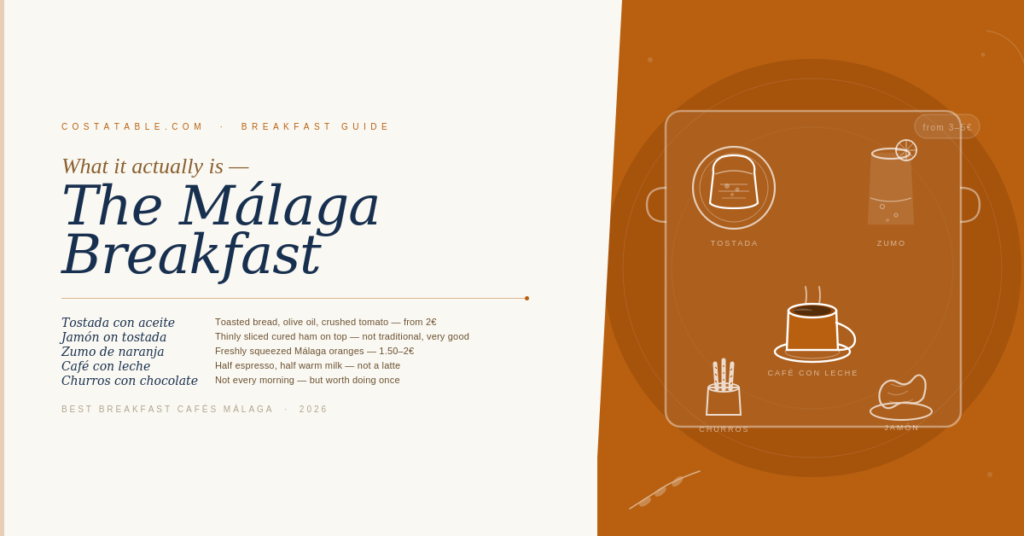
Before getting into specific places, it is worth being clear about what a proper Málaga breakfast looks like. This matters because the tourist version — avocado toast, acai bowls, granola with yoghurt — exists in the city, is perfectly fine, and is covered separately in the brunch guide for Málaga. The traditional breakfast is a different thing, and it is the thing worth seeking out if you have not had it.
Tostada con aceite y tomate. A thick slice of bread — pan de cristal or a good sourdough-adjacent white loaf, not the sliced supermarket kind — toasted until the outside has some structure and the inside is still soft. Topped with olive oil and crushed fresh tomato. Sometimes with a thin layer of butter underneath, though purists argue against it. The quality of the olive oil makes an enormous difference. At a good traditional bar, this costs around two euros and is one of the better things you can eat in the morning anywhere in Spain.
Tostada con aceite. Same thing without the tomato. Simpler, and sometimes the better option when the tomatoes are not at their peak — which, outside of summer, is more often than you would think.
Jamón on tostada. Some bars add a layer of thinly sliced cured ham on top. Not traditional in the strictest sense but very good when the jamón is decent quality.
Freshly squeezed orange juice. Málaga grows its own oranges — small, slightly rough-skinned, intensely flavoured varieties that are nothing like the imported oranges at most breakfast tables in northern Europe. A glass of zumo de naranja natural at a good bar costs around one-fifty to two euros and tastes noticeably different from the same thing made anywhere else. Order it every morning.
Café con leche. Half espresso, half warm milk, served in a glass or a small cup depending on the bar. This is not a flat white or a latte. It is its own thing, slightly stronger than you expect, and at a good traditional bar it is made on a machine that has been calibrated for this purpose. The Málaga coffee vocabulary is specific: a sombra has more milk, a solo is straight espresso, a mitad is exactly half and half, a corto is a short pull. Order with confidence.
Churros con chocolate. Not every morning, but worth doing once. Fried dough sticks dipped in very thick hot chocolate — not the thin drinking chocolate variety but something closer to melted dark chocolate in a cup. This is the traditional Sunday morning breakfast in Málaga, eaten after a late night or a long morning walk. Several traditional bars do this properly. It is filling, calorific, and completely worth it.
Traditional breakfast bars
What to look for
The best traditional breakfast bars in Málaga have a few things in common. They are busy from around 8am. The clientele at that hour is mostly people on their way to work — construction workers, shopkeepers, office workers — not tourists. The bar itself is usually zinc or marble, the coffee machine is large and old, and the bread is toasted on a grill rather than in a pop-up toaster. The prices are low without being a signal of poor quality.
One practical note: at a traditional bar, you stand at the counter or sit on a stool. If there are tables, they are for slightly later in the morning. The standing breakfast is faster and cheaper, and at the best bars it is the right way to do it.
Casa Aranda
Casa Aranda is not a hidden gem — it appears in enough places that the crowds can be significant on weekends — but it earns its reputation. This is the reference point for churros con chocolate in Málaga. The chocolate is thick and dark. The churros are fried to order, hot, and slightly crisp on the outside. The room is loud, fast, and does not apologise for any of this. You eat standing up or perched on a stool at a small shelf counter. Go on a weekday morning to avoid the worst of the crowds.
The location in the Atarazanas Market area means it works well as part of a morning that includes the market itself — coffee and churros first, then a walk around the stalls before the fish is gone.
The market bars
The stalls and bar counters inside the Atarazanas Market itself serve breakfast from around 8am until the market winds down around 1:30pm. These are not cafés in any conventional sense — they are market counters where you stand and eat — but the experience is specific to Málaga in a way that few things are. Fresh orange juice squeezed to order, a coffee made on a small machine behind a fish stall, a tostada eaten while the morning trade happens around you.
This is the hidden gems approach to breakfast — finding the experience inside the institution rather than in the café across the road from it. If you are visiting the market anyway, eat inside it.
Traditional neighbourhood bars
The best traditional breakfast bars are in residential neighbourhoods rather than the tourist circuit. The streets around the Atarazanas Market (Calle Especerías, Calle Nueva, Calle Atarazanas) have several. The Lagunillas neighbourhood north of the historic centre has others that are almost entirely local in their trade. Pedregalejo and El Palo along the eastern coast have bars that have been doing the same breakfast for forty years.
The formula for finding them: walk until you see a bar with a coffee machine visible through the door, a handwritten menu on the wall or a small chalkboard, and people standing at the counter. Go in and order a tostada and a café con leche. The total will be under three euros. The quality will be good.
Specialty coffee breakfast spots
What has changed
The specialty coffee movement arrived in Málaga later than in Madrid or Barcelona, but it has arrived properly. There are now several cafés in the city — concentrated in Soho and the lower centro — that source their beans carefully, use good extraction equipment, and employ baristas who know what they are doing. These are the places to go if you want to taste what the coffee actually tastes like rather than what coffee generally tastes like.
The breakfast offer at specialty cafés tends to be smaller and more considered than at traditional bars. You are more likely to find a good croissant or a house-made pastry than a tostada, though some of the better places do both.
Desal Café
Desal is the most reliable all-round breakfast spot among Málaga’s specialty cafés. The coffee is consistently well-extracted, the tostadas are made with proper bread and good olive oil, and the pastry selection changes often enough to be interesting. The room is calm, which makes it particularly good in the morning before the day gets complicated. It is also one of the few specialty cafés in the city where a traditional Málaga breakfast — tostada, juice, coffee — is executed at the same level as the more contemporary options.
The hidden gems guide covers Desal in more detail, including the small terrace that works well on good mornings. It is worth reading before you go.
Mia Coffee Shop

Mia is smaller and more focused than Desal, built primarily around the coffee itself. The breakfast offer is limited — a pastry or two, simple — but if the coffee is the main event of your morning, this is where the extraction is most carefully considered. The room suits solo breakfast: quiet, unhurried, the kind of place where you drink your coffee without feeling rushed toward the door.
Kima Coffee
Kima represents the newer wave of Málaga specialty coffee. The approach is technically precise — pour-over, single-origin options, baristas who can tell you where the beans came from and why — and the space is modern without being cold. For a breakfast that centres on the coffee experience, Kima is the best option in Soho. The food offer is light, which suits the format.
Breakfast by neighbourhood
El Centro
The historic centre has the widest range of breakfast options at every price point. The challenge, as always, is avoiding the tourist-facing places on the main pedestrian streets. Walk one block back from Calle Larios and the quality improves significantly. The streets around the Carmen Thyssen Museum and the Atarazanas Market have the highest concentration of good traditional breakfast bars.
For terrace breakfast specifically — tostadas eaten outside in the morning sun — the terrace café guide for Málaga covers the best outdoor options in the centre, including which squares get morning sun and which are still in shade until late morning.
Soho
Soho breakfast is a different rhythm from the centro. The specialty cafés here open between 8:30am and 9:30am — later than traditional bars — and the morning offer skews toward better coffee and contemporary pastries rather than tostadas and churros. This is the place to come for a slower, more considered breakfast after 9am.
The neighbourhood is quieter than the centro in the morning, which matters in spring and autumn when the light is good and you want to sit outside without being moved along. Walking through Soho at 9am with a good coffee is one of the better starts the city offers.
Pedregalejo and El Palo
The eastern coastal neighbourhoods have the best setting for breakfast and some of the most reliably authentic traditional bars. The seafront chiringuitos that serve coffee and tostadas in the morning — with the Mediterranean directly in front of you and almost no tourist trade — are worth the extra twenty-five minutes it takes to get here from the centre.
El Palo specifically has several old-school bars where the breakfast has not changed in decades. These are the places the hidden gems guide points toward for anyone who wants to eat where the neighbourhood eats rather than where the guides send visitors.
Practical notes on breakfast in Málaga
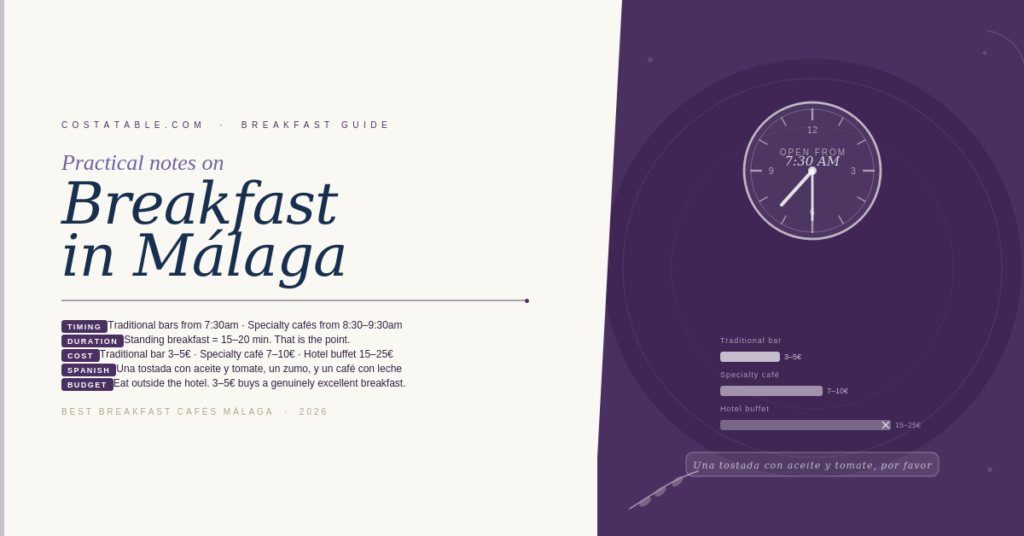
When to go: Traditional bars start breakfast service from around 7:30am and run it through to noon. Specialty cafés open later — usually 8:30am to 9:30am. The busiest period at both is between 8am and 9:30am on weekdays. On weekends, the pace is slower and the crowds come later.
How long it takes: A standing breakfast at a traditional bar — tostada, coffee, juice — takes fifteen to twenty minutes. That is the point. It is not a slow meal. If you want to linger over breakfast, either go to a specialty café with tables or aim to arrive after the weekday rush, when the bar settles into a more relaxed pace.
What it costs: At a traditional bar, a full breakfast — tostada, juice, café con leche — costs between three and five euros. At a specialty café, the same combination runs to seven to ten euros depending on the pastry. At hotel breakfast buffets, you are paying fifteen to twenty-five euros for an experience that is broadly inferior to either. Eat outside the hotel.
Ordering in Spanish: You do not need much. Una tostada con aceite y tomate, un zumo de naranja, y un café con leche, por favor covers the full traditional breakfast. The bar staff at traditional places appreciate the attempt and will help if you get it wrong.
Budget travel note: Breakfast is where Málaga’s value is most obvious. Three to five euros for a good meal — fresh juice, good olive oil, proper coffee — is exceptional value by any European standard. If you are travelling on a budget, front-loading your eating into breakfast and lunch, and going lighter in the evenings, makes the most of what the city does best at the lowest cost. For broader tips on stretching your budget in Spain without compromising on quality, the budget travel guide to Spain on Lifecosmo covers practical strategies that apply directly to a Málaga trip.
| Format | Opens | Full breakfast price | What you get | Best for |
|---|---|---|---|---|
| Traditional bar | 7:30am | €3 – €5 | Tostada, fresh OJ, café con leche. Eaten standing at the counter in 15 minutes | Eating like the city actually eats. Best value in Málaga. |
| Specialty café | 8:30 – 9:30am | €7 – €10 | Better coffee, house pastry or croissant. Sit-down, slower pace, quieter room | When the coffee matters as much as the food. Soho is the best area. |
| Market stalls (Atarazanas) | 8am | €2 – €4 | Pressed OJ, tostada or fried fish, espresso. Standing only. Closes by 1:30pm | The most Málaga experience available. Go if you are visiting the market anyway. |
| Hotel buffet | 7am | €15 – €25 | Everything, but usually not done as well as the alternatives outside | When you cannot leave the hotel. Otherwise, skip it. |
| Seafront chiringuito (El Palo) | 8am | €3 – €5 | Tostada, coffee, sometimes fresh fish. Mediterranean directly in front of you | When you want the sea alongside the tostada. Worth the extra 25 minutes. |
How this connects to the rest of the day
Breakfast is the start of the Málaga eating day, not the whole of it. Once the morning is done, the best lunch spots in Málaga covers the midday meal in full — including the menú del día, the market options, and the neighbourhood restaurants worth finding. For the evening, the best dinner restaurants in Málaga covers everything from casual tapas to proper tasting menus.
If you want to start the morning sitting outside, the terrace café guide for Málaga is the right place to start — covering the best outdoor café settings from the historic centre to Pedregalejo. And for the complete picture of the city’s eating landscape, the best restaurants in Málaga guide covers all mealtimes in one place.
What I order — every time
My standard breakfast order in Málaga
- A tostada con aceite y tomate. Always. If the olive oil is poor I know immediately and I know where I stand with the rest of the bar.
- Un zumo de naranja natural. Every morning without exception. It is too good and too cheap to skip. Two euros. Pressed while you wait.
- Un café con leche. At a traditional bar I order a mitad — exactly half and half. At a specialty café I ask what they recommend on filter that morning.
- Churros con chocolate once per trip. Saturday morning, after the market, at Casa Aranda or whichever traditional bar is doing it that week. Not every day. Once.
- I stand at the counter. At a traditional bar, this is the right way to do it. Faster, cheaper, and you are in the room rather than watching it from a table in the corner.
Further reading
Breakfast in the historic centre tastes better when you know what you are looking at. Understanding the streets, the architecture, and the history of the quarter you are walking through gives the morning a different texture.
For transport, opening times, and general city orientation, the official Málaga city tourism website is the most reliable practical resource.
Frequently asked questions
What time do cafés serve breakfast in Málaga? Traditional bars start from 7:30am and serve breakfast through to around noon. Specialty cafés open later — usually between 8:30am and 9:30am. On weekends, most places operate on a slightly later schedule. If you want to eat before 8am, you are limited to the earliest traditional bars and hotel breakfast rooms.
What is the traditional breakfast in Málaga? A tostada — thick toasted bread — with olive oil and crushed fresh tomato, a glass of freshly squeezed orange juice, and a café con leche. The total at a good traditional bar costs between three and five euros. It is the most consistently good cheap meal in the city.
Where is the best area for breakfast in Málaga? It depends on what you want. For the widest range, the streets around the Atarazanas Market in El Centro are the most reliable. For seafront setting and local atmosphere, Pedregalejo and El Palo. For specialty coffee and a slower pace, Soho. For churros specifically, the Atarazanas Market area and Casa Aranda.
How much does breakfast cost in Málaga? At a traditional bar, a full breakfast — tostada, juice, coffee — costs three to five euros. At a specialty café, expect seven to ten euros. Hotel breakfast buffets typically cost fifteen to twenty-five euros and are rarely worth it when the alternative is this good and this cheap.
What is a café con leche in Málaga? Half espresso, half warm milk, served in a glass or small cup. Málaga has its own coffee vocabulary: a sombra has more milk, a solo is straight espresso, a mitad is exactly half and half, a corto is a short pull with less water. Locals order precisely. It is worth learning the vocabulary.
Can I get a vegan breakfast in Málaga? At traditional bars, the tostada with olive oil and tomato is naturally vegan and good. Beyond that, traditional breakfast culture does not cater specifically for vegan diets. At specialty cafés in Soho, plant-based milk options are increasingly available and the pastry selection sometimes includes vegan options. Ask when you arrive.
Last updated: May 22, 2026. Opening hours and menus change — check before visiting.

Frank Petersen is co-founder of CostaTable and lives just outside Málaga, where everyday life naturally revolves around food, cafés, and local restaurants. With a strong interest in finding places that actually deliver - not just look good - he spends much of his time exploring both well-known spots and those that are easier to miss.
His focus is simple. To cut through the noise and highlight places that are worth visiting, whether it’s a relaxed brunch, a good coffee, or a dinner that feels right from start to finish.
Through CostaTable, Frank aims to give readers a more honest and useful guide to the food scene in Málaga, helping them spend less time searching and more time enjoying.